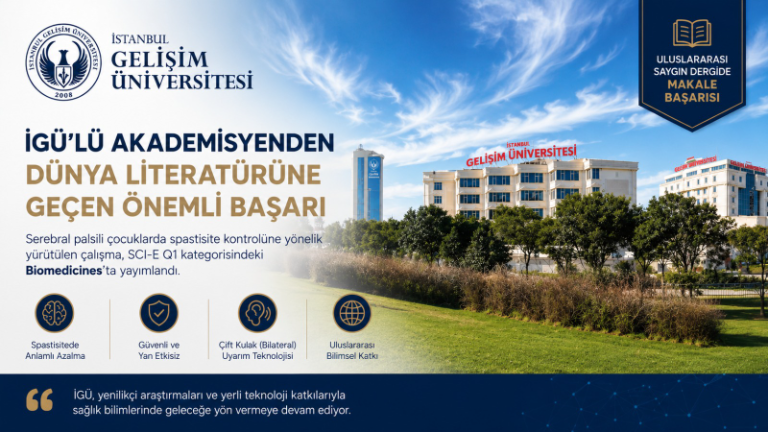

İstanbul Gelişim University (IGU), which draws attention for its research-focused approach, international collaborations, and innovative scientific work, continues to contribute to the global world of science through research carried out in the health sciences. The work conducted within the university's interdisciplinary research culture not only produces academic knowledge but also pioneers the development of innovative solutions that directly affect public health. In this context, an international study in which Res. Asst. Görkem Açar from the Sports Management Department of İstanbul Gelişim University's Faculty of Sport Sciences participated as a researcher has secured an important place in the world literature with its findings on spasticity control in children with cerebral palsy.
An Innovative Approach to Spasticity in Children with Cerebral Palsy
While cerebral palsy is regarded as one of the most common neurodevelopmental disorders seen in childhood, spasticity —one of the most important symptoms of the condition — significantly affects the quality of life of those living with it. This condition, presenting with involuntary muscle stiffness and spasms, leads to important limitations in walking, balance, activities of daily living, and independent movement abilities.Although various treatment approaches are currently applied to control spasticity, the search for a method that provides lasting and effective results continues. High-cost neuromodulation technologies developed in recent years continue to be discussed in the scientific community in terms of efficacy and long-term safety.
A Domestically Developed Bilateral Stimulation Technology Researched for the First Time in the World
In response to this need, Res. Asst. Görkem Açar and colleagues researched, for the first time in the world, the effects of the domestically developed Vagustim device — featuring bilateral (both-ear) stimulation capability — in children with cerebral palsy.The efficacy of transcutaneous auricular vagus nerve stimulation (taVNS) — the method used in the research — in reducing spasticity levels in children with cerebral palsy was scientifically assessed. The study findings also provided important data in terms of demonstrating the safety and clinical applicability of the method.
Published in an Internationally Respected Journal
The research findings were published in the internationally respected scientific journal Biomedicines, classified in the Q1 category within SCI-E. The findings obtained showed that taVNS application significantly reduces spasticity levels in children with cerebral palsy and did not produce any side effects or safety concerns during the application process.In addition, the study showed that vagus nerve stimulation not only contributes to the regulation of muscle tone but may also be effective in improving autonomic nervous system functions.
Opening New Horizons in the Treatment of Neurological Diseases
The study, which is pioneering in its field, sheds light on the development of next-generation, non-invasive, and safe treatment approaches for the control of spasticity seen in cerebral palsy, as well as in stroke, multiple sclerosis (MS), and similar neurological diseases.These results — obtained with a domestically developed technology created by Turkish scientists — demonstrate our country's research capacity in health technologies and neurorehabilitation, while once again putting the spotlight on İstanbul Gelişim University's contribution to international scientific output.
The study, in which İstanbul Gelişim University's Faculty of Sport Sciences Sports Management Department Res. Asst. Görkem Açar participated as a researcher, is regarded as an important indicator of the university's scientific research vision and its approach to academic output that creates impact on a global scale.